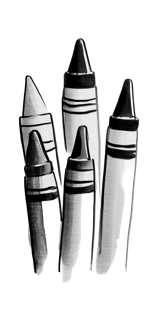
Before I ever smudged ink across a page, before detentions and hooked wrists, and before the word “cack-handed” drifted across a classroom, there was a crayon.
I don’t remember it myself. I was small. Three, perhaps four. Old enough to grip colour. Not old enough to understand ideology.
I picked up a crayon with my left hand.
My grandma, well-intentioned and practical in the way of her generation, gently took it from my fingers and placed it in my right hand.
My mother, who as a child had her own crayons quietly redirected, took it and set it down in front of me.
“Let him be who he is,” she said.
Apparently, this happened more than once.
The crayon passed between hands like a relay baton in a very polite domestic tug-of-war. No raised voices. No drama. Just three generations negotiating what was “proper”.
My mum had been made to switch. My grandma believed she was helping. I — totally unaware — simply wanted to draw.
I sometimes think about how many small corrections shape a person. A hand nudged here. A habit redirected there. How easily differences can be smoothed into conformity.
In our house, it wasn’t.
And so I grew up left-handed.
Survival Rule #1: Claim the Left-Hand Seat
If you take nothing else from this book, take this:
Always sit on the left-hand side of a shared desk.
School desks are not neutral territory. They are built with an assumption. Most tables assume elbows will move from left to right. Most classrooms assume wrists will travel safely away from freshly written words.
They do not account for collisions.
My best friend at school was right-handed. On the first day we shared a desk, I sat on the right-hand side. It seemed harmless enough. We were nine. Geography books between us. Ink pens poised.
Within minutes, we were engaged in an accidental fencing match.
His arm moved right.
Mine moved left.
Clash.
Again.
Clash.
There is no quicker way to test a friendship than repeated elbow contact during silent writing time.
We switched seats the next day.
Harmony was restored.
If you can share with a fellow left-hander, of course, it doesn’t matter. You may flail freely in symmetrical chaos. But in mixed company, positioning is everything.
Consider it tactical seating.
Hazard Level: Ink
Ink is a trap.
At school, we were required to write in pen. Pencils were deemed temporary, unreliable and suspiciously erasable.
In the early 1980s, the pens we were given were not quite fountain pens — those had already turned me into a walking ink-blot experiment — but they weren’t quick-drying either. The weapon of choice in our classroom was almost certainly a Berol Handwriting Pen. Red — or sometimes a defiantly bright orange — barrel. Blue cap. Plastic nib.
Iconic.
It was not a biro. Biros — those miraculous quick-drying inventions — were apparently unavailable to us. Perhaps they were locked in a cupboard somewhere, reserved for a more obedient cohort. Biros, we were told, were too slippery. Too casual. Too prone to encouraging reckless penmanship. Ink, we were assured, built character.
The Berol used water-based liquid ink — closer in spirit to a draughtsman’s pen than to the thick, obedient paste of a ballpoint. The plastic fibre tip provided friction. Resistance. Control.
For a right-hander, this was sensible pedagogy.
For a left-hander, it was sabotage disguised as tradition.
The ink did not dry quickly. It lingered. It waited.
And as my hand moved steadily across the page, carefully forming each loop and tail, it would follow behind and drag itself through the sentence I’d just written.
A slow-motion undoing.
Evidence of my crime smeared across the side of my palm. Smudged vowels. Blurred consonants. Whole thoughts merged into fog.
Why Biros Were Banned
There were reasons, of course.
Teachers believed biros were too smooth, encouraging messy, rushed handwriting. Liquid ink required less pressure and promoted a lighter grip. It was washable. It felt formal. A rite of passage from pencil to “proper” writing.
All of this made sense.
Unless you were pushing the pen rather than pulling it.
English moves from left to right. A right-hander pulls the nib away from their hand. A left-hander pushes the nib forward, straight into the still-wet line of thought.
Add the slight friction of the fibre tip — designed to aid control — and occasionally the pen would catch or skip when pushed at an awkward angle.
Progress became negotiation.
The Adaptations
Left-handed children in the Berol era developed strategies.
Some became “underwriters,” positioning the hand below the line of writing to avoid dragging across the ink entirely.
Some rotated the page dramatically clockwise — sometimes to near-vertical — and wrote downward, side-on to the sentence.
Some placed a scrap of paper beneath the heel of the hand. A makeshift blotter. A sacrificial layer.
I developed the hook.
“Cack-handed,” someone would say.
A joke.
Almost.
It’s a curious word. Playful on the surface. Slightly comic. But it carries the suggestion of clumsiness — of doing something badly. As though the fault did not lie with the ink, nor the desk, nor the design of the world, but with the hand itself.
I wasn’t careless.
I was left-handed.
I learnt to adapt.
My wrist arched up and over the line of writing, curled like a question mark suspended above the page. It wasn’t elegant. It was structural engineering. I needed to give the ink time to dry before I reached it.
Even then, I would sometimes miscalculate. A word here or there would blur beneath the side of my hand.
For this, I was occasionally kept behind.
Sometimes detention was earned fairly — forgotten homework, daydreaming, insufficient enthusiasm for long division. But often it was for “corrective handwriting”.
In ink.
Slowly.
With the hand that caused the difficulty in the first place.
How helpful.
I don’t tell you this for sympathy. There are greater injustices in the world than smudged exercise books.
But there is something quietly formative about being told, repeatedly, that the way you naturally move through a system is slightly wrong.
You begin to believe you are clumsy when, in fact, you are simply counter-directional.
And yet.
I also learnt something else.
I learnt to adapt.
To observe.
To anticipate the drag of my own hand across a sentence.
To sit strategically.
To hook my wrist like a small architect of ink.
My grandma tried to turn my left hand into a right one.
My school tried to straighten it.
My mum let it be.
And in between all of that, I learnt how to survive.
Zero Gravity
There is an old story from the Space Race.
Writing in space, as it turns out, is not straightforward. Most pens rely on gravity to draw ink down toward the nib. Remove gravity, and the ink simply sits there, uncooperative.
It is often said that NASA spent millions developing a pen that would work in zero gravity, while the Russians sensibly used pencils.
The truth is slightly less dramatic. Pencils proved hazardous — graphite dust and floating splinters are not ideal companions in a sealed spacecraft — and a pressurised pen was eventually developed that could write upside down, underwater, and in space.
The lesson remains.
Tools are designed for environments.
Change the environment, and the tool must change too.
Left-handers do not live in zero gravity.
But we do live in an environment that was not entirely designed for us.